Physics Revision Hub

⚛️ 1. Modern Physics (Complete JEE Guide)

1. Dual Nature of Radiation and Matter

Is section mein photon energy aur de-Broglie wavelength sabse zyada pucha jata hai.

Energy of a Photon: $E = h\nu = \frac{hc}{\lambda}$
Shortcut: $E (\text{in eV}) \approx \frac{12400}{\lambda (\text{in \AA})}$ ya $\frac{1240}{\lambda (\text{in nm})}$
Einstein’s Photoelectric Equation: $K_{max} = eV_0 = h\nu - \phi$
(Yahan $V_0$ stopping potential hai aur $\phi$ (work function) = $h\nu_{threshold}$)
de-Broglie Wavelength: $\lambda = \frac{h}{p} = \frac{h}{mv} = \frac{h}{\sqrt{2mK}}$
For an electron: $\lambda \approx \sqrt{\frac{150}{V}} \text{ \AA} \approx \frac{12.27}{\sqrt{V}} \text{ \AA}$
Example: Agar ek metal ka work function $2.0 \text{ eV}$ hai aur uspar $4000 \text{ \AA}$ ki light girti hai, to stopping potential kya hoga?
Solution: $E = \frac{12400}{4000} = 3.1 \text{ eV}$.
Ab, $K_{max} = 3.1 - 2.0 = 1.1 \text{ eV}$. Isliye, $V_0 = 1.1 \text{ V}$.

2. Atomic Structure (Bohr’s Model)

*Formulas sirf hydrogen-like atoms ($Z = 1, 2, 3 \dots$) ke liye valid hain.

Radius of $n^{th}$ orbit: $r_n = 0.529 \frac{n^2}{Z} \text{ \AA}$
Velocity in $n^{th}$ orbit: $v_n = 2.19 \times 10^6 \frac{Z}{n} \text{ m/s}$
Energy in $n^{th}$ orbit: $E_n = -13.6 \frac{Z^2}{n^2} \text{ eV}$
Wavelength: $\frac{1}{\lambda} = RZ^2 \left( \frac{1}{n_1^2} - \frac{1}{n_2^2} \right)$
(Rydberg constant $R \approx 1.097 \times 10^7 \text{ m}^{-1}$)

3. Nuclear Physics

Mass-Energy Equivalence: $E = \Delta m \cdot c^2$
Unit: $1 \text{ amu} = 931.5 \text{ MeV}$
Nuclear Radius: $R = R_0 A^{1/3}$ ($R_0 \approx 1.2 \text{ fm}$)
Decay Law: $N = N_0 e^{-\lambda t}$
Half-life: $T_{1/2} = \frac{0.693}{\lambda}$
Activity (A): $A = \lambda N$
Example: Half-life $20 \text{ mins}$ hai, kitne time baad $75\%$ decay ho jayega?
Solution: $75\%$ decay = $25\%$ ($1/4$) bacha hai. $1 \xrightarrow{T_{1/2}} 1/2 \xrightarrow{T_{1/2}} 1/4$.
Do half-lives lagenge. Total time = $2 \times 20 = \mathbf{40 \text{ mins}}$.

4. Semiconductors

Mass Action Law: $n_e \cdot n_h = n_i^2$
Conductivity: $\sigma = e(n_e \mu_e + n_h \mu_h)$
Logic Gates: Practice AND, OR, NOT, NAND, NOR.
*JEE Tip: NAND/NOR se basic gates banane ke questions zaroor dekhein.
Topic Key Concept Master Formula
Photons Energy-Wavelength $E = 12400/\lambda$
Photoelectric Max KE $K_{max} = h\nu - \phi$
Matter Waves de-Broglie $\lambda = h/\sqrt{2mqV}$
Atoms Energy Levels $E_n = -13.6 Z^2/n^2$
Nuclei Decay $N/N_0 = (1/2)^{t/T_{1/2}}$
X-Rays Moseley's Law $\sqrt{\nu} = a(Z - b)$
⚡ 2. Current Electricity (High Weightage)

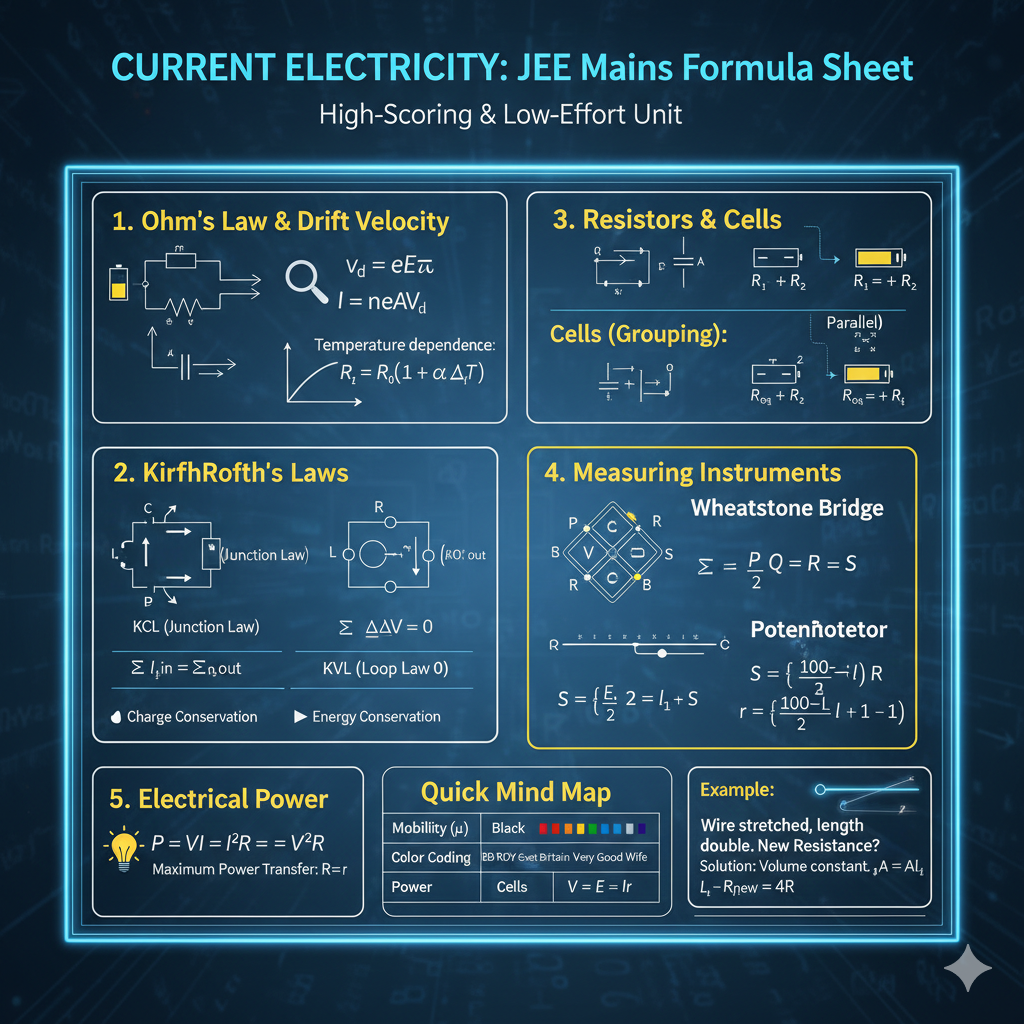
📊 Visual: Current Electricity Concept Map

Current Electricity Diagram

1. Ohm’s Law and Drift Velocity

Drift Velocity ($v_d$): $v_d = \frac{eE\tau}{m} = \frac{eV\tau}{mL}$
Current & $v_d$: $I = neAv_d$
Resistance: $R = \rho \frac{L}{A}$ | Temperature: $R_t = R_0(1 + \alpha \Delta T)$
🔥 Stretching Wire Shortcut: Agar wire ko kheench kar length $n$ times ki jaye, toh naya Resistance $n^2$ times ho jata hai.
Example: Length double ($n=2$) karne par $R_{new} = 2^2 \times R = 4R$.

2. Kirchhoff’s Laws (KCL & KVL)

KCL (Junction Law): $\sum I_{in} = \sum I_{out}$ (Based on Charge Conservation)
KVL (Loop Law): $\sum \Delta V = 0$ (Based on Energy Conservation)

3. Cells & Instruments

Parallel Cells: $E_{eq} = \frac{\frac{E_1}{r_1} + \frac{E_2}{r_2}}{\frac{1}{r_1} + \frac{1}{r_2}}$ | $r_{eq} = \frac{r_1 r_2}{r_1 + r_2}$
Potentiometer: $\frac{E_1}{E_2} = \frac{l_1}{l_2}$ | Internal Resistance $r = R \left( \frac{l_1}{l_2} - 1 \right)$
Power: $P = VI = I^2R = \frac{V^2}{R}$
Topic Key Concept Master Formula
Mobility ($\mu$) Velocity per unit Field $\mu = v_d / E$
Color Coding BB ROY Great Britain... Value = $AB \times 10^C \pm D\%$
Power Heat Dissipation $H = I^2Rt$
Cells Terminal Voltage $V = E - Ir$
💡 Max Power Theorem: Power maximum tab transfer hogi jab External $R$ = Internal $r$.
⚡ 3. Electrostatics & Capacitance (High Weightage)

1. Coulomb's Law & Electric Field

Coulomb's Force: $F = \frac{k q_1 q_2}{r^2}$ | $k = 9 \times 10^9 \text{ Nm}^2/\text{C}^2$
Electric Field (E): $E = \frac{F}{q} = \frac{kQ}{r^2}$
Infinite Wire: $E = \frac{2k\lambda}{r}$ | Infinite Sheet: $E = \frac{\sigma}{2\epsilon_0}$
Sphere (Outside): $E = \frac{kQ}{r^2}$ | Sphere (Inside): $E = 0$

2. Potential & Gauss’s Law

Potential (V): $V = \frac{kQ}{r}$ | Relation: $E = -\frac{dV}{dr}$
Potential Energy: $U = \frac{k q_1 q_2}{r}$ | Work: $W = q\Delta V$
Gauss’s Law: $\phi = \oint \vec{E} \cdot d\vec{A} = \frac{q_{in}}{\epsilon_0}$

3. Electric Dipole

Dipole Moment: $\vec{p} = q(2l)$ (-ve to +ve)
Torque: $\vec{\tau} = \vec{p} \times \vec{E} = pE \sin\theta$
Energy: $U = -\vec{p} \cdot \vec{E} = -pE \cos\theta$
Axial Field: $E \approx \frac{2kp}{r^3}$ | Equatorial: $E \approx \frac{-kp}{r^3}$

4. Capacitance

Capacitance: $C = \frac{Q}{V}$ | Parallel Plate: $C = \frac{A\epsilon_0}{d}$
Dielectric (K): $C' = \frac{KA\epsilon_0}{d}$
Energy Stored: $U = \frac{1}{2}CV^2 = \frac{Q^2}{2C}$
Energy Density: $u = \frac{1}{2}\epsilon_0 E^2$
Example (8 Drops Combine): Agar 8 small drops (charge q, radius r) combine hokar ek big drop banati hain, to potential kya hoga?

Solution: Charge $Q = 8q$. Volume $\frac{4}{3}\pi R^3 = 8 \times \frac{4}{3}\pi r^3 \implies R = 2r$.
Naya Potential $V' = \frac{k(8q)}{2r} = 4 \left( \frac{kq}{r} \right) = \mathbf{4V}$.
Quantity Relation/Formula Unit
Force$F = k \frac{q_1q_2}{r^2}$Newton (N)
Field$E = F/q$V/m or N/C
Potential$V = W/q$Volt (V)
Flux$\phi = EA \cos\theta$V-m
Capacitance$C_{parallel} = C_1 + C_2$Farad (F)

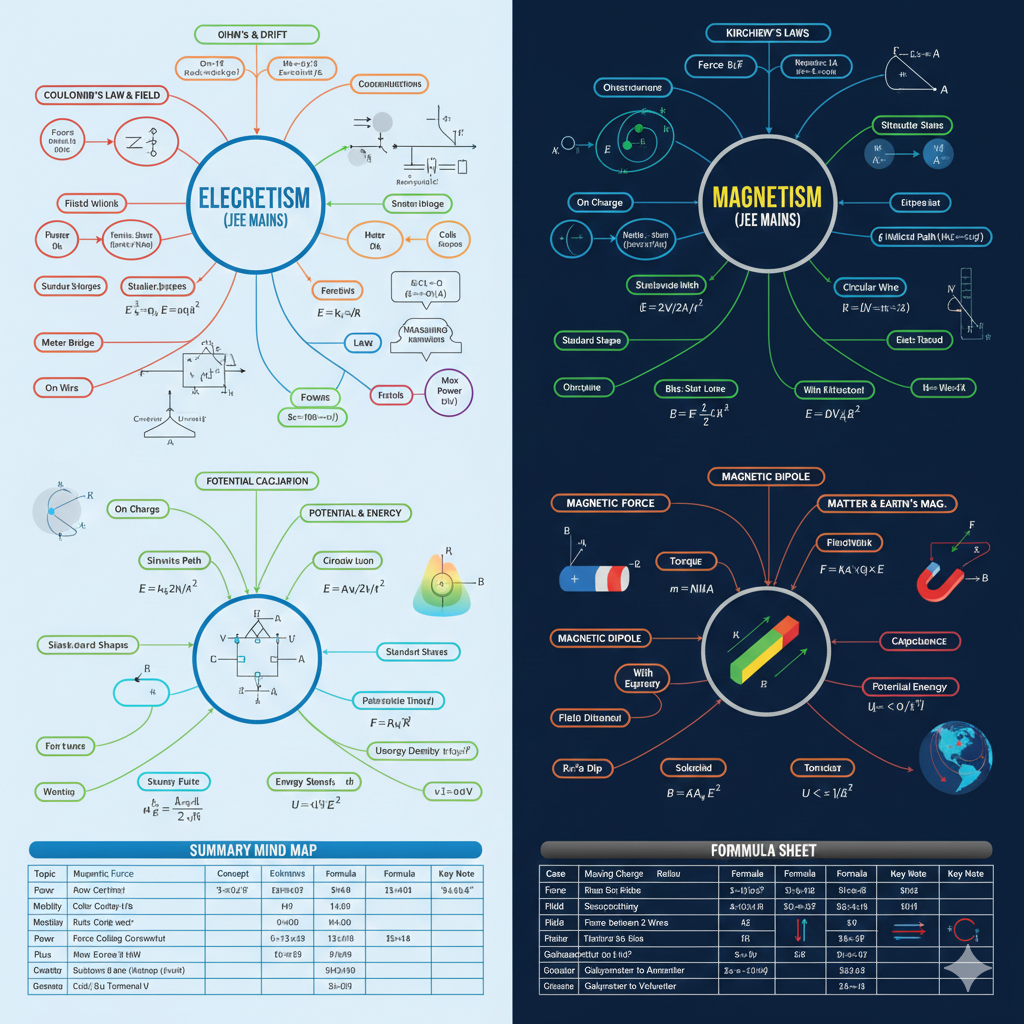
📊 Visual: Electrostatics Summary Map

Electrostatics Diagram
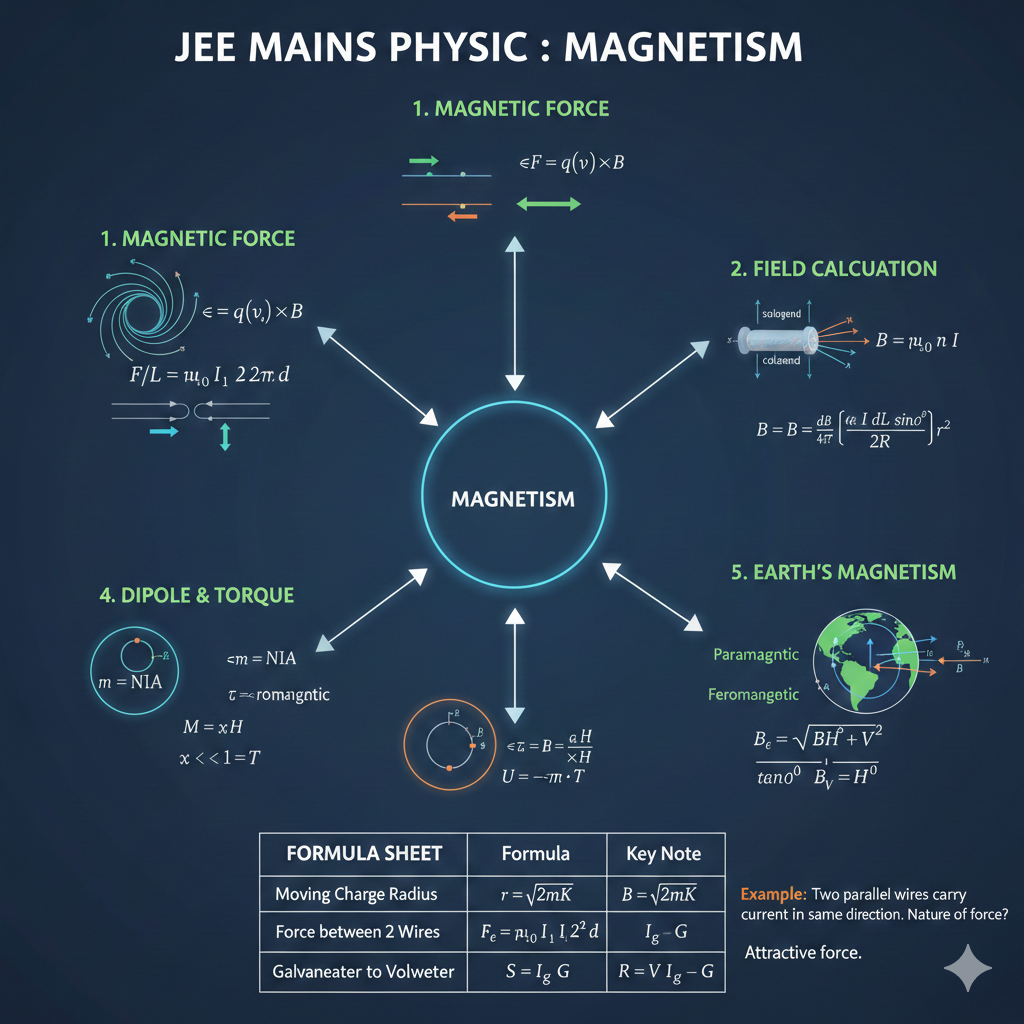
🧲 4. Moving Charges & Magnetism

1. Magnetic Force

Force on Charge: $\vec{F} = q(\vec{v} \times \vec{B}) = qvB \sin\theta$
Circular Path: $r = \frac{mv}{qB}$ (Jab $\theta = 90^\circ$)
Helical Path: $\text{Pitch} = \frac{2\pi mv \cos\theta}{qB}$
Force on Wire: $\vec{F} = I(\vec{L} \times \vec{B}) = ILB \sin\theta$

2. Magnetic Field (Standard Shapes)

Straight Wire (Infinite): $B = \frac{\mu_0 I}{2\pi r}$
Circular Loop (Center): $B = \frac{\mu_0 I}{2R}$
Circular Loop (Axis): $B = \frac{\mu_0 I R^2}{2(R^2 + x^2)^{3/2}}$
Solenoid: $B = \mu_0 n I$ | Toroid: $B = \frac{\mu_0 N I}{2\pi R}$

3. Dipole, Torque & Matter

Magnetic Moment: $m = NIA$ | Torque: $\vec{\tau} = \vec{m} \times \vec{B}$
Potential Energy: $U = -\vec{m} \cdot \vec{B} = -mB \cos\theta$
Curie's Law: $\chi \propto \frac{1}{T}$ (Paramagnetic ke liye)

4. Earth's Magnetism (High Yield)

Total Field: $B_e = \sqrt{B_H^2 + B_V^2}$
Angle of Dip ($\theta$): $\tan\theta = \frac{B_V}{B_H}$
Pole par $\theta = 90^\circ$ | Equator par $\theta = 0^\circ$
Case Formula Key Note
Moving Charge $r = \frac{\sqrt{2mK}}{qB}$ $K$ = Kinetic Energy
Force (2 Wires) $\frac{F}{L} = \frac{\mu_0 I_1 I_2}{2\pi d}$ Same direction = Attract
Ammeter Conv. $S = \frac{I_g G}{I - I_g}$ Shunt in Parallel
Voltmeter Conv. $R = \frac{V}{I_g} - G$ Resistance in Series
💡 JEE Tip: Jab do wires mein current same direction mein hota hai toh woh attract karte hain, aur opposite mein repel.
🔌5. Electromagnetic Induction & AC

1. Electromagnetic Induction (EMI)

Magnetic field se electricity generate karne ka process.

Magnetic Flux ($\phi$): $\phi = \vec{B} \cdot \vec{A} = BA \cos \theta$
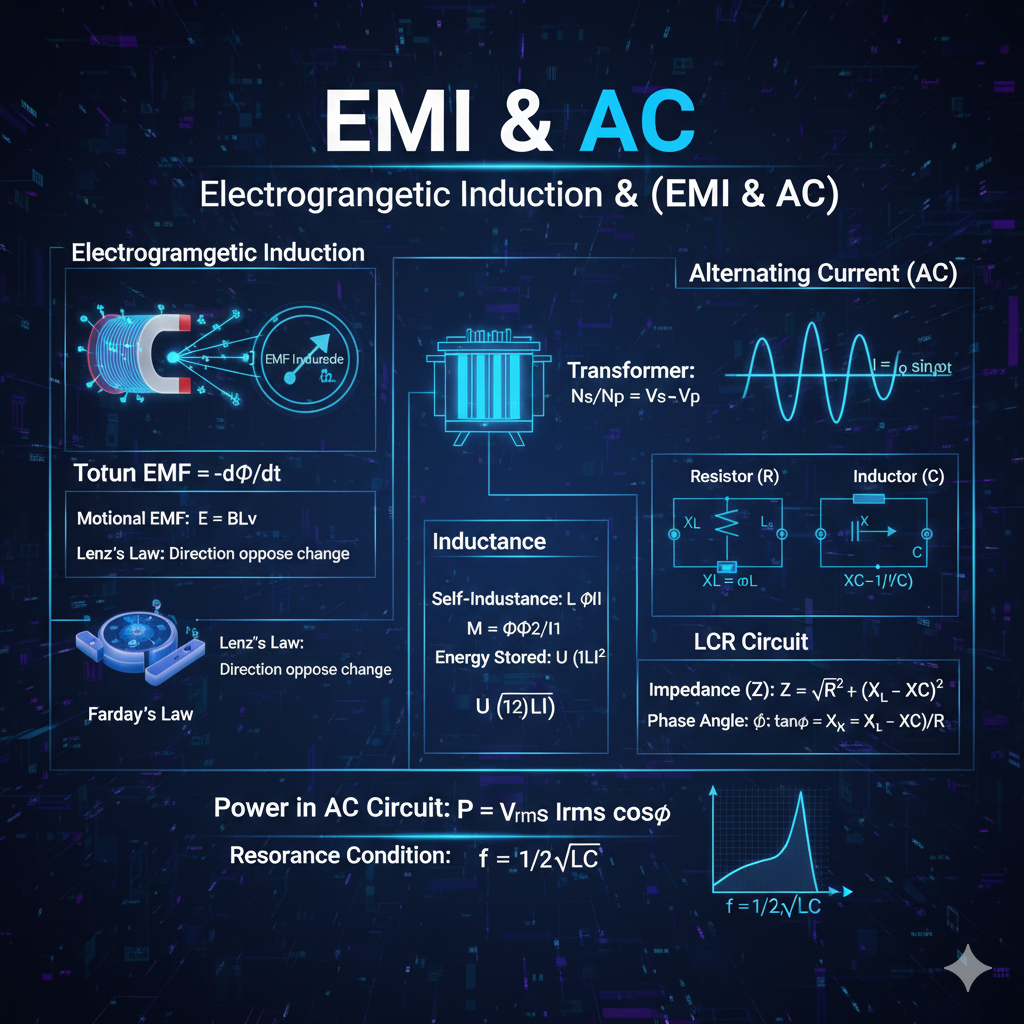
Faraday's Law: $e = -\frac{d\phi}{dt}$ (EMF is rate of change of flux)
Lenz's Law: Induced current hamesha apne 'cause' ka oppose karta hai.
Motional EMF: $e = BvL$ (Wire moving in B-field)
Self-Inductance (L): $\phi = LI$ | Energy $U = \frac{1}{2}LI^2$
Mutual Inductance (M): $\phi_2 = MI_1$

2. Alternating Current (AC)

RMS Value: $I_{rms} = \frac{I_0}{\sqrt{2}} \approx 0.707 I_0$ (Gharon mein 220V RMS hota hai)
Reactance: $X_L = \omega L$ | $X_C = \frac{1}{\omega C}$
Impedance (Z): $Z = \sqrt{R^2 + (X_L - X_C)^2}$
Resonance ($X_L = X_C$): $f = \frac{1}{2\pi\sqrt{LC}}$ | Current maximum hota hai.
Power Factor: $\cos \phi = \frac{R}{Z}$ | $P_{avg} = V_{rms}I_{rms} \cos \phi$

3. Transformer

Relation: $\frac{V_s}{V_p} = \frac{N_s}{N_p} = \frac{I_p}{I_s}$
Step-up: $N_s > N_p$ (Voltage badhata hai)
Step-down: $N_s < N_p$ (Voltage ghatata hai)

Key Components Summary

Device Property Formula
Inductor Opposes current change $V_L = L \frac{dI}{dt}$
Capacitor Blocks DC, allows AC $X_C = 1/\omega C$
LCR Circuit Phase difference $\tan \phi = \frac{X_L - X_C}{R}$
Quality Factor Sharpness of Resonance $Q = \frac{1}{R} \sqrt{\frac{L}{C}}$

📊 Visual: Transformer & LCR Circuit

EMI and AC Diagram
🔭6. Ray & Wave Optics (High Weightage)

1. Ray Optics (Geometrical Optics)

Core Logic: Light travels in straight lines.

A. Reflection & Mirrors:
• Mirror Formula: $\frac{1}{v} + \frac{1}{u} = \frac{1}{f}$
• Magnification: $m = -\frac{v}{u} = \frac{f}{f-u}$
• Silvering of Lens: $P_{eq} = 2P_L + P_M$
B. Refraction & Lenses:
• Snell's Law: $n_1 \sin i = n_2 \sin r$
• Lens Maker's Formula: $\frac{1}{f} = (n_{rel}-1)(\frac{1}{R_1} - \frac{1}{R_2})$
• Lens Formula: $\frac{1}{v} - \frac{1}{u} = \frac{1}{f}$
Cutting: Horizontal (f same), Vertical ($2f$).
C. Prism & TIR:
• TIR Condition: $i > \theta_c$ (Denser to Rarer) | $\sin \theta_c = \frac{1}{n}$
• Prism Formula: $n = \frac{\sin(\frac{A+\delta_m}{2})}{\sin(A/2)}$
• Deviation (Thin Prism): $\delta = (n-1)A$

2. Wave Optics (Physical Optics)

Resultant Intensity: $I = I_1 + I_2 + 2\sqrt{I_1 I_2} \cos \phi$
YDSE Fringe Width: $\beta = \frac{\lambda D}{d}$
Shift due to Slab: $S = (\mu - 1)t$
Brewster's Law: $n = \tan i_p$ | Malus' Law: $I = I_0 \cos^2 \theta$

3. Optical Instruments

Instrument Magnification (M) Length (L)
Simple Microscope $1 + \frac{D}{f}$ -
Compound Microscope $(\frac{v_o}{u_o})(1 + \frac{D}{f_e})$ $v_o + u_e$
Astronomical Telescope $f_o / f_e$ $f_o + f_e$
💡 Tricky Point: Agar setup ko water ($n$) mein dip karein, toh $\lambda_{new} = \lambda/n$ aur fringe width ($\beta$) bhi $n$ times ghat jati hai.

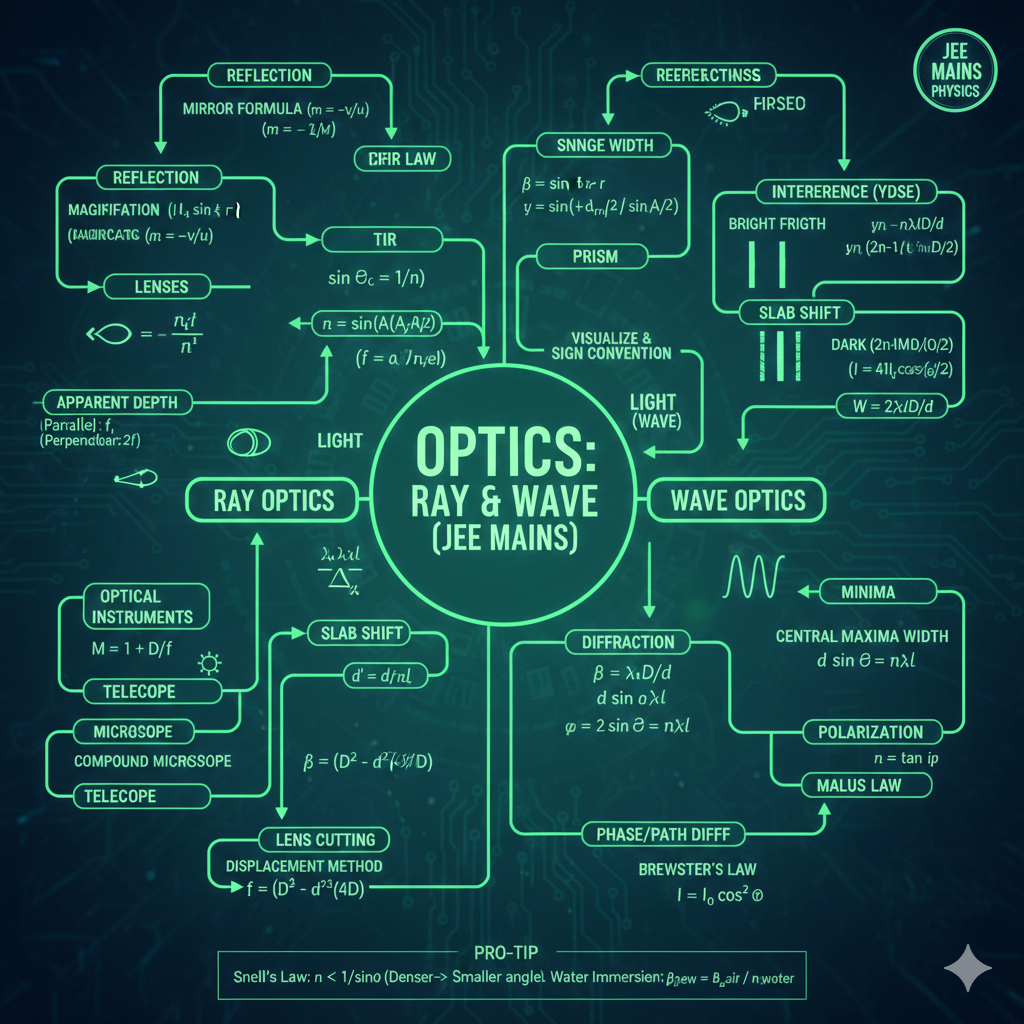
📊 Visual: Ray & Wave Optics Summary

Optics Diagram
🔥7. KTG & Thermodynamics (Thermal Physics)

1. Kinetic Theory of Gases (KTG)

Gas molecules ke microscopic behavior ka study.

Ideal Gas Eq: $PV = nRT = Nk_BT$
Pressure: $P = \frac{1}{3} \rho v_{rms}^2$
Velocities:
   - $v_{rms} = \sqrt{\frac{3RT}{M}}$ | $v_{avg} = \sqrt{\frac{8RT}{\pi M}}$ | $v_{mp} = \sqrt{\frac{2RT}{M}}$
Internal Energy (U): $U = \frac{f}{2}nRT$
Degrees of Freedom (f):
   - Monoatomic: $f=3$ | Diatomic: $f=5$ | Polyatomic: $f=6$

2. Laws of Thermodynamics

First Law (FLOT): $\Delta Q = \Delta U + W$ (Energy Conservation)
Sign Convention: Heat given (+ve), Work done by system (+ve)
$\gamma$ (Adiabatic Index): $\gamma = \frac{C_p}{C_v} = 1 + \frac{2}{f}$

3. Specific Heat & Heat Engines

Mayer's Relation: $C_p - C_v = R$
Carnot Efficiency ($\eta$): $\eta = 1 - \frac{T_{sink}}{T_{source}} = \frac{W}{Q_{in}}$
Refrigerator (COP $\beta$): $\beta = \frac{Q_{low}}{W} = \frac{T_{sink}}{T_{source} - T_{sink}}$
Note: Temperature hamesha Kelvin mein lein.

Process Comparison Table

Process Condition Work Done (W)
Isochoric $\Delta V = 0$ $0$
Isobaric $\Delta P = 0$ $P\Delta V$
Isothermal $\Delta T = 0$ $nRT \ln(V_f/V_i)$
Adiabatic $\Delta Q = 0$ $\frac{P_1V_1 - P_2V_2}{\gamma - 1}$
💡 Tricky Concept: Isothermal expansion mein $\Delta U = 0$ hota hai kyunki Internal energy sirf temperature par depend karti hai.

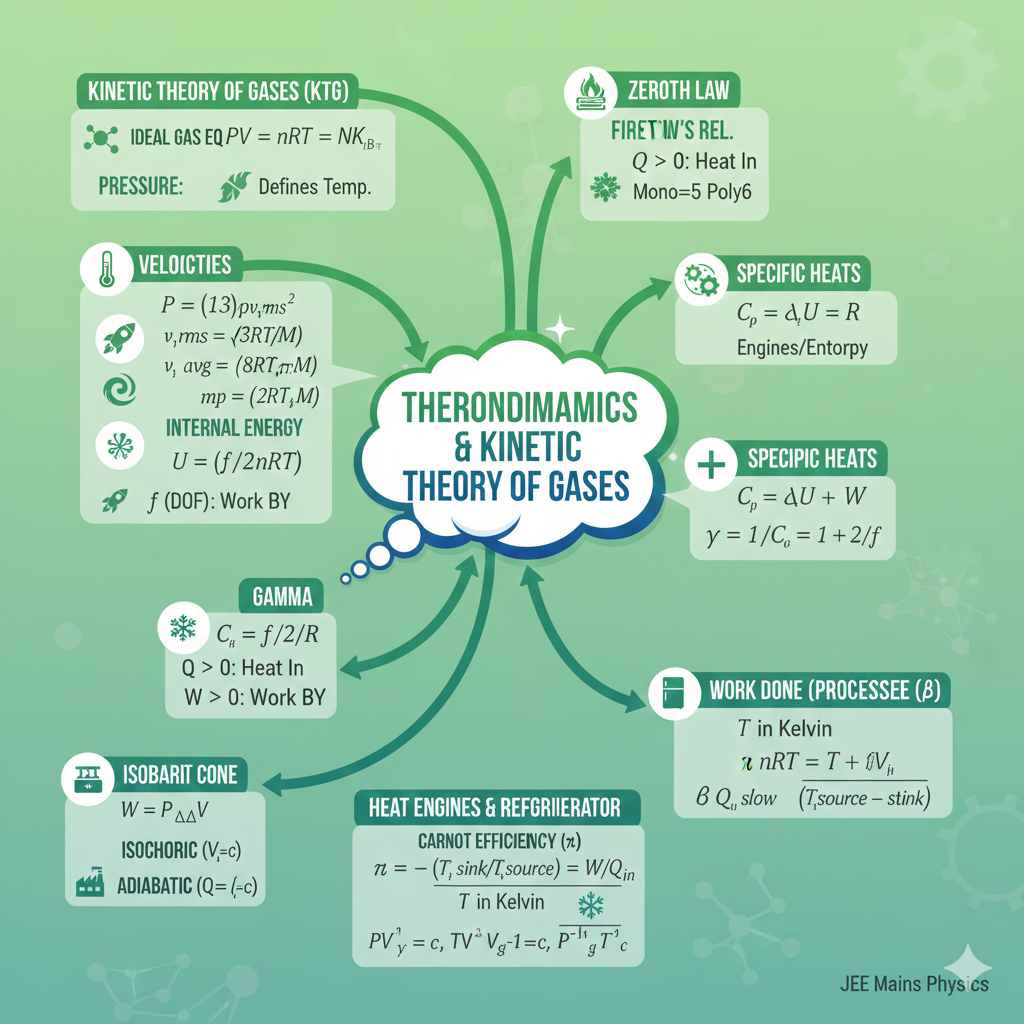
📊 Visual: Thermodynamic Processes & PV Diagrams

Thermodynamics Diagram
⚡8. UNITS & DIMENSIONS (MASTER SHEET)
📏9. ERROR ANALYSIS (FULL SUMMARY)
⚙️10. WORK, ENERGY & POWER (FULL CHAPTER)

Physics Mastery: How to Score 80+ in JEE Mains Physics

JEE Mains mein Physics ek aisa subject hai jo aapki rank decide karta hai. Aksar students formulas toh yaad kar lete hain, lekin jab sawal thoda twist hokar aata hai, toh wo phans jate hain. Physics sirf mathematics nahi hai, ye nature ko samajhne ka ek nazariya hai. Agar aapne concepts ki "Feel" le li, toh complex numericals bhi asaan ho jayenge. Is blog mein hum baat karenge un pillars ki jo aapki Physics ko strong banayenge...

Modern Physics & Optics: Your Shortcut to 99+ Percentile

JEE Physics mein kuch aise units hain jo "Rank Booster" ka kaam karte hain. Modern Physics aur Optics isi category mein aate hain. Jahan Mechanics mein aapko lambi calculations karni padti hain, wahi Modern Physics mein agar aapko formula aur concept pata hai, toh aap 30 seconds mein sawal solve kar sakte hain. Optics, doosri taraf, aapki geometry aur ray-tracing skills ka imtehaan leta hai. Is blog mein hum dekhenge ki in units ko kaise master karein...

Heat & Thermodynamics: Mastering the Science of Energy

Thermodynamics Physics ka wo hissa hai jo micro-level particles ki energy ko macro-level work mein badalna seekhata hai. JEE Mains mein Heat aur Thermodynamics se har saal 3 se 4 sawal aate hain. Sabse acchi baat ye hai ki agar aapne is unit ko Physics mein dhang se padh liya, toh Chemistry ka Thermodynamics bhi kaafi had tak cover ho jata hai. Is blog mein hum dekhenge ki Carnot Engine se lekar Entropy tak, har concept ko kaise asaan banayein...

Electromagnetism: Mastering the Core of JEE Physics

Electromagnetism JEE Physics ka sabse bada aur mahatvapurn pillar hai. Isme Electrostatics se lekar Alternating Current tak sab kuch shamil hai. Aksar students is unit ke bade-bade integration aur complex circuits se dar jate hain, lekin agar aapne "Field aur Potential" ka core logic samajh liya, toh ye unit aapki rank ko boost karne ka sabse bada zariya ban sakti hai. Is final blog mein hum electromagnetism ke har ek pahlu ko simplify karenge...